English is a door that opens up countless opportunities in study and work. However, many English learners often face a major barrier in expanding and consolidating their vocabulary. A lack of vocabulary not only makes it difficult to grasp grammar but also directly affects listening, speaking, reading, and writing skills. So, how can we learn English vocabulary effectively, helping us memorize quickly and retain long-term?
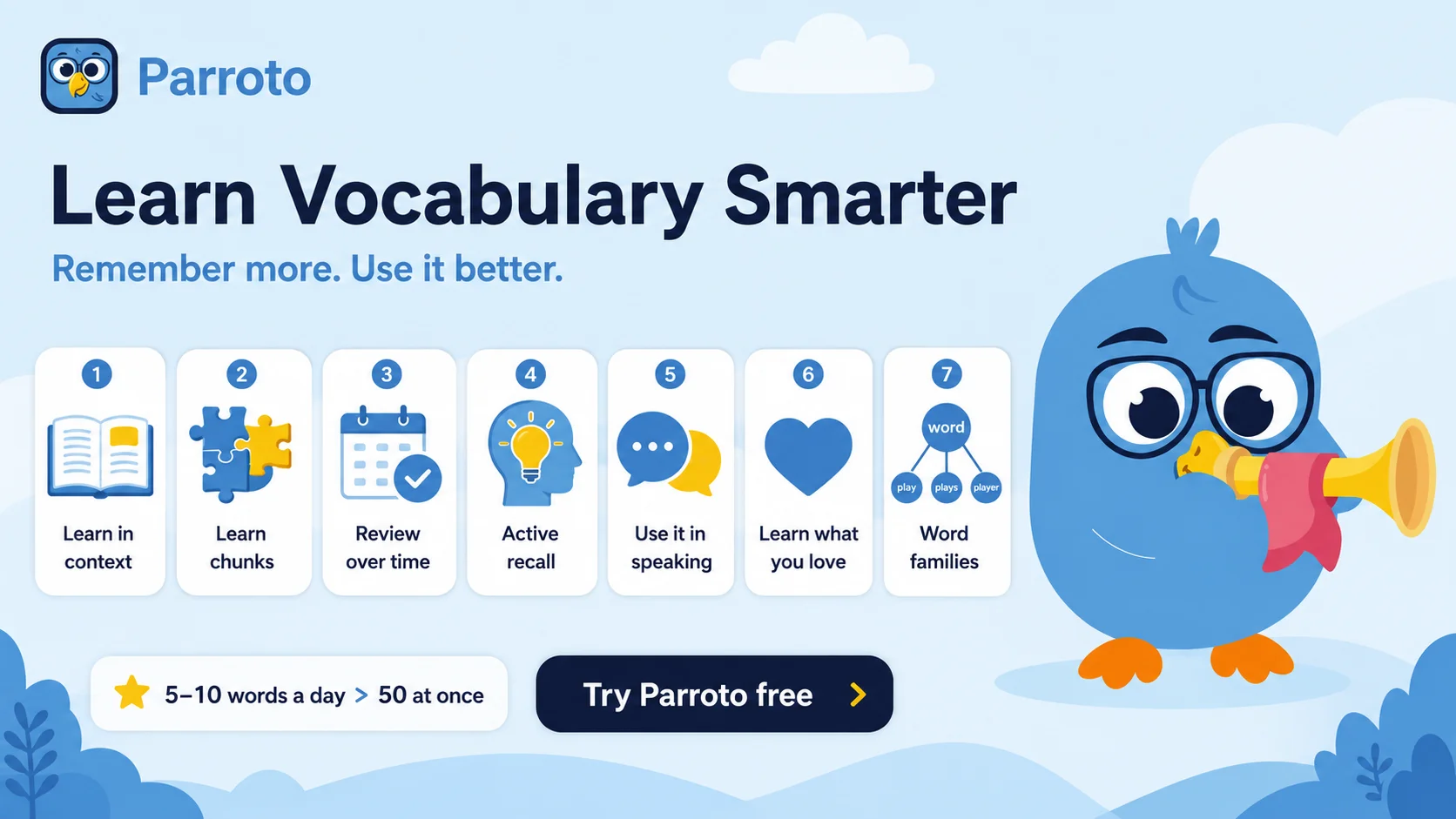
This article will delve into English vocabulary learning methods that have been scientifically proven, analyzing the pros and cons of each approach. The goal is to equip you with optimal strategies to build a solid vocabulary, and you will discover how Parroto (parroto.app/) can become a powerful companion on this journey.
Core Principles for Effective Vocabulary Learning:
- Categorize vocabulary by topic: Focus on groups of nouns related to daily life, work, and hobbies for easy systematization.
- Grasp nuances through synonyms/antonyms: Especially useful for verbs and adjectives, helping you use words more accurately and flexibly.
- Utilize English-Vietnamese dictionaries: An ideal starting point for beginner English learners, saving time on looking up meanings.
- Learn root words and word families: Expand your vocabulary quickly by mastering different word forms derived from a single root.
- Apply spaced repetition: The golden method to transfer vocabulary from short-term to long-term memory.
1. Learning English Vocabulary by Topic: Building Foundational Nouns
One of the most effective ways to learn English vocabulary, especially for nouns, is to group them by specific topics. This helps your brain organize information systematically, rather than learning individual words randomly. When words are related, the ability to memorize vocabulary significantly improves.
Examples:
- Topic "Travel":
airport,passport,luggage,destination,souvenir,hotel,ticket. - Topic "Technology":
smartphone,application,software,hardware,artificial intelligence,network. - Topic "Cuisine":
cuisine,ingredient,recipe,chef,spicy,sweet,sour,bitter.
Advantages:
- Easy systematization: Related words help the brain arrange information more logically.
- Increased association: Learning words within a topic context helps you visualize and apply them to real-life situations.
- Supports review: Reviewing by topic is far more effective than trying to remember a list of unrelated words.
Disadvantages:
- Mainly suitable for nouns; verbs and adjectives are sometimes difficult to categorize clearly by topic.
With Parroto, you can easily create or discover diverse thematic vocabulary lists, personalized to match your interests and needs. Visit parroto.app to start building your own thematic vocabulary library!

2. Approaching Vocabulary Through Synonyms - Antonyms: Understanding Nuances & Increasing Flexibility
For verbs and adjectives, the English vocabulary learning method through synonyms and antonyms is extremely useful. It not only helps you expand your vocabulary but also trains your ability to perceive and use language subtly and appropriately in context.
Examples of synonymous adjectives:
- Happy:
happy,cheerful,joyful,ecstatic,elated. - Sad:
sad,melancholic,gloomy,downcast,dejected. - Fast:
quick,rapid,swift,speedy.
Examples of antonymous verbs:
accept/rejectbuild/demolishpraise/criticize
Advantages:
- Effective systematization: Helps you easily memorize vocabulary in both short-term and long-term memory.
- Improved accuracy: Understanding the subtle differences between synonyms helps you choose the most appropriate word for the context.
Disadvantages:
- Care must be taken with nuances of meaning. Not all synonyms can be used interchangeably in all cases.
Important note on nuances:
For example, big and enormous both mean "large," but enormous emphasizes a superior size. If you're talking about a large cat, big cat is appropriate; but to describe an elephant, enormous elephant would create a stronger impression.

3. Benefits of Using an English-Vietnamese Dictionary for Beginners
Many experts recommend using an English-English dictionary to understand vocabulary more deeply. This is true, but only suitable for English learners at an intermediate level or higher. For beginner learners, using an English-Vietnamese dictionary offers many practical benefits.
Examples:
| Vocabulary | Vietnamese Meaning | English Explanation (for intermediate learners and above) |
|---|---|---|
procrastinate |
Trì hoãn | To delay or postpone action; put off doing something until a later time. |
ubiquitous |
Phổ biến khắp nơi | Present, appearing, or found everywhere. |
serendipity |
Sự tình cờ may mắn | The occurrence and development of events by chance in a happy or beneficial way. |
Advantages:
- Time-saving: Quickly grasp the meaning of vocabulary, making the learning process smoother.
- Easy access: Especially useful when encountering completely new words without clear context.
Disadvantages:
- Limited nuance: Some vocabulary can be difficult to translate perfectly from English to Vietnamese, easily leading to misunderstandings or inappropriate word usage.
Example of nuance discrepancy:
The words lonely and alone can both be translated as "cô đơn" or "một mình". However, alone refers to the physical state of being by oneself, while lonely implies a feeling of sadness, lacking companionship. "I like to be alone sometimes" is different from "I feel lonely without my friends".

4. Expanding Vocabulary with Word Families (Root Words and Their “Relatives”)
In English, a root word can generate various word forms (nouns, verbs, adjectives, adverbs). This English vocabulary learning method not only helps you expand your vocabulary but also trains your ability to guess word meanings and use words more flexibly in listening, speaking, reading, and writing skills.
Examples:
| Root Word | Root Meaning | Derived Words |
|---|---|---|
develop |
Phát triển | development, developer, developing |
educate |
Giáo dục | education, educational, educator |
create |
Tạo ra | creation, creative, creator |
analyse |
Phân tích | analysis, analytic (or analytical), analyst |
Advantages:
- Accelerates vocabulary expansion: From one root word, you can learn many new words at once.
- Improves meaning guessing ability: Helps you infer the meaning of new words based on familiar root words.
- Enhances grammatical accuracy: Understanding word families helps you use the correct word form in sentences, thereby improving grammar and sentence structure.
Disadvantages:
- There are no general rules for adding suffixes to form different word types. Learners need to remember each case.

5. Vocabulary Review Secrets for Long-Term Retention (Spaced Repetition)
Learning without reviewing makes it difficult to retain vocabulary long-term. To ensure vocabulary enters long-term memory, strategic review is essential. Spaced Repetition is the golden key to this.
Effective review and memorization steps:
- Combine diverse methods: Don't stick to just one learning approach. Be flexible and combine thematic learning, synonyms/antonyms, and word families.
- Focus on pronunciation and spelling: When learning a new word, always look up its phonetic transcription and practice standard pronunciation. This not only helps you speak correctly but also improves listening skills. At the same time, practice spelling vocabulary to effectively support writing skills.
- Spaced repetition schedule: This is the most scientific way to retain vocabulary long-term. Instead of cramming, break down review time into increasing cycles:
- After 1 hour of learning.
- After 1 day of learning.
- After 3 days of learning.
- After 7 days of learning.
- After 1 month of learning.
- And continue to maintain periodically.
- Use Flashcards and Smart Tools: Traditional flashcards or vocabulary learning apps are excellent tools for applying spaced repetition.
- Apply in practice: The best way to retain vocabulary long-term is to use them. Try to incorporate new words into your sentences, writings, or daily communication situations.
Parroto is designed based on an advanced spaced repetition algorithm. The system will automatically remind you to review vocabulary at the right time to optimize long-term memorization. Additionally, Parroto integrates features for practicing standard pronunciation and checking vocabulary spelling, helping you comprehensively improve your English. Experience these smart features at parroto.app to see the difference!

Conclusion
Learning English vocabulary effectively is no longer an insurmountable challenge if you apply the right methods. From systematizing by topic, delving through synonyms/antonyms, expanding with word families, to optimizing long-term vocabulary retention with spaced repetition, each strategy contributes to building a strong vocabulary.
Start your vocabulary conquest journey today! Discover Parroto at parroto.app to turn learning English vocabulary into an enjoyable experience, making it quick to learn and long to remember like never before. Parroto is committed to providing you with a personalized learning path, helping you achieve your English goals most effectively.