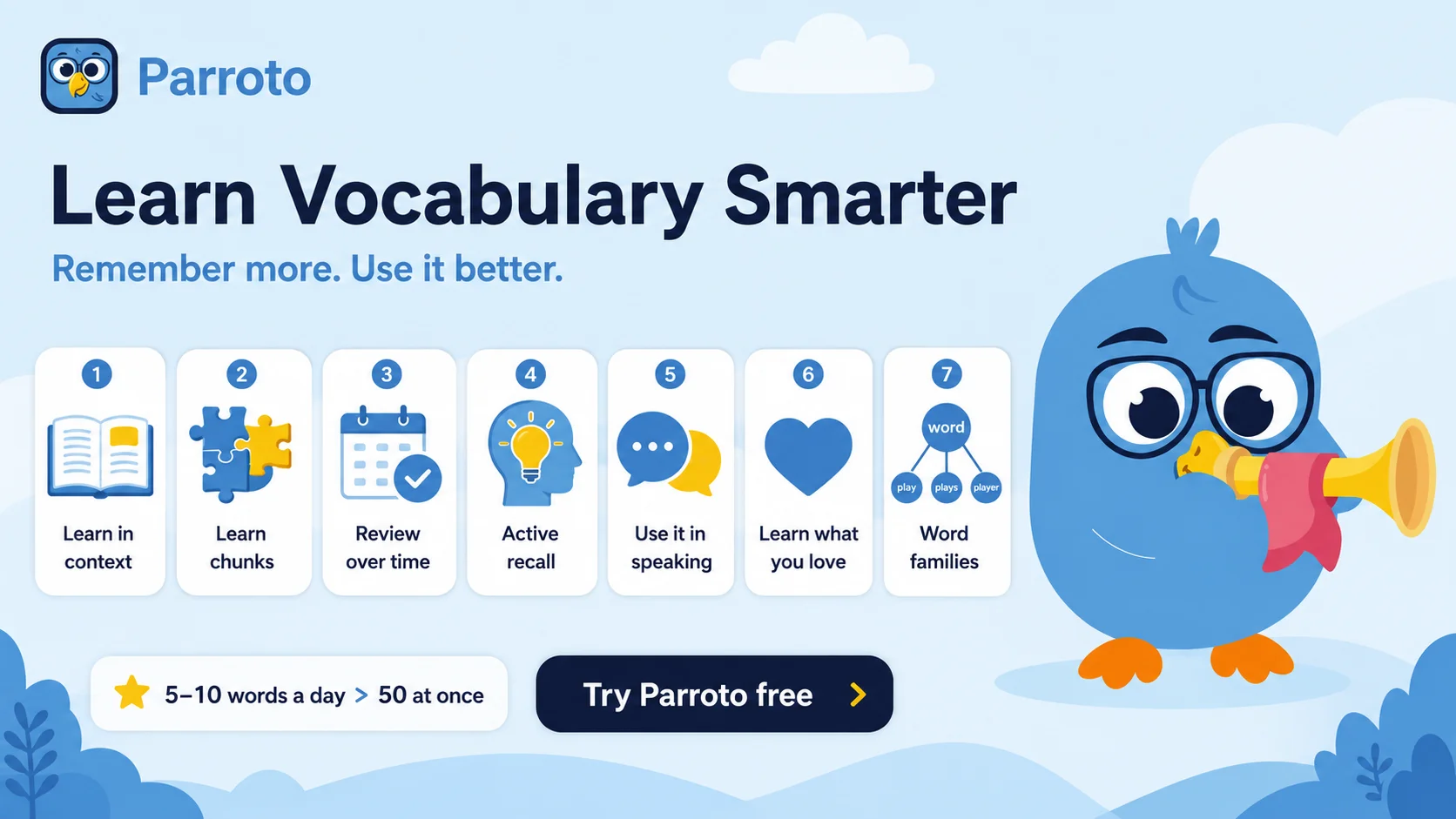
How to Actively Learn Vocabulary
Most of us have done this: copied a list of 50 new words into a notebook, read them over and over a few times, then closed the notebook feeling like we've learned. A week later, we encounter the exact same word in a sentence and can't recall its meaning.
The problem isn't that you're lazy or have a poor memory. The problem is the learning method. Rereading a list of words is a passive learning approach – your brain only recognizes the visual form of the word, but can't retrieve its meaning when needed. Simply switching to an active learning method will significantly improve your retention, and might even save you time.
Why You Should Learn Actively
Active learning revolves around a simple principle from memory science, called active recall: instead of rereading the answer, you force your brain to retrieve the answer from memory. Each "retrieval" is a reinforcement, like a gym workout for your memory. The more you have to struggle to remember a bit, the more firmly the word sticks.
Four Truly Effective Active Vocabulary Learning Methods
1. Test Yourself Instead of Rereading
The smallest but most important change: cover the meaning, look at the word, and recall the meaning in your head (or say it out loud). Only check the answer after you've tried to remember. This is the mechanism of flashcards and why flashcards have existed for hundreds of years and remain effective: they force you to recall, not just skim.
A small tip to make it stronger: try to recall in both directions. Look at the English word → recall the meaning, then look at the Vietnamese meaning → recall the English word. The second direction is harder but it's the one you need when speaking.

2. Learn Words in Context, Not in Isolation
A word standing alone is difficult to remember and even harder to use. What does "run" mean? To run, to operate, to manage, to organize an event, ink bleeding... The meaning lies in the sentence, not in the word itself.
So instead of learning "overwhelming = áp đảo" (overpowering), remember the whole sentence where you encountered it: "The support was overwhelming." Then you not only remember the meaning, but also know what the word goes with, and in what situation it's used – meaning you learn to use it, not just to memorize it.
3. Break It Down, Learn Consistently, Don't Cram
You set a goal to "learn 50 words today," get tired after 15, give up, and then feel like a failure, making you reluctant to open it the next day. An overly large goal is what causes you to quit, not a lack of discipline.
Your brain remembers much better when you spread out your learning instead of cramming it all at once – this principle is called spaced repetition. Learning 7 words every day for a week far surpasses learning 50 words in one session and forgetting them all. Small goals also have a psychological benefit: they're easy to achieve, and each achievement makes you want to come back the next day.

4. Create Your Own Vocabulary Flashcards
There's a phenomenon in cognitive psychology called the generation effect: something you create yourself is remembered much better than something you're given ready-made. When you decide which words are worth saving, write down meanings in your own understanding, and choose example sentences – your brain has processed that word much more deeply than if you simply downloaded a pre-made deck.
This is also why "5000 common words" vocabulary decks you download often sit unused: they're not yours. The most effective flashcard deck is one that contains exactly the words you just encountered and found difficult – because those are the words you truly need.

Use Parroto's vocabulary cards to turn theory into habit
The difficulty with active learning isn't understanding the principles – the four points above aren't complicated. The difficulty is consistency: creating cards yourself, remembering review schedules, and testing yourself daily is quite cumbersome, and if it's cumbersome, people quit. This is where Parroto's vocabulary cards are designed to reduce friction for you.
Create cards exactly as you want. You're not restricted to words Parroto suggests. You can create your own deck, add any words you want, write meanings and notes in your own understanding, and organize them into sets by topic or goal – IELTS vocabulary, words for work, words picked up from watching movies. The act of building this deck yourself activates the generation effect, so it's both a storage method and a learning session.
The system handles your review schedule. You don't need to remember "when I learned this word, when should I review it again." Parroto's spaced repetition system (SRS) algorithm automatically selects the right time to present each word for review – just before you're about to forget it. Your job is simply to open the app and answer. Active learning via flashcards, on a scientifically optimal schedule, without any self-management.
Stay motivated so you don't give up halfway. The hardest part of maintaining consistency is supported by daily streaks and vocabulary leaderboards – turning a 5-minute daily review into a feedback-driven habit, rather than a lonely, easily forgotten chore.