
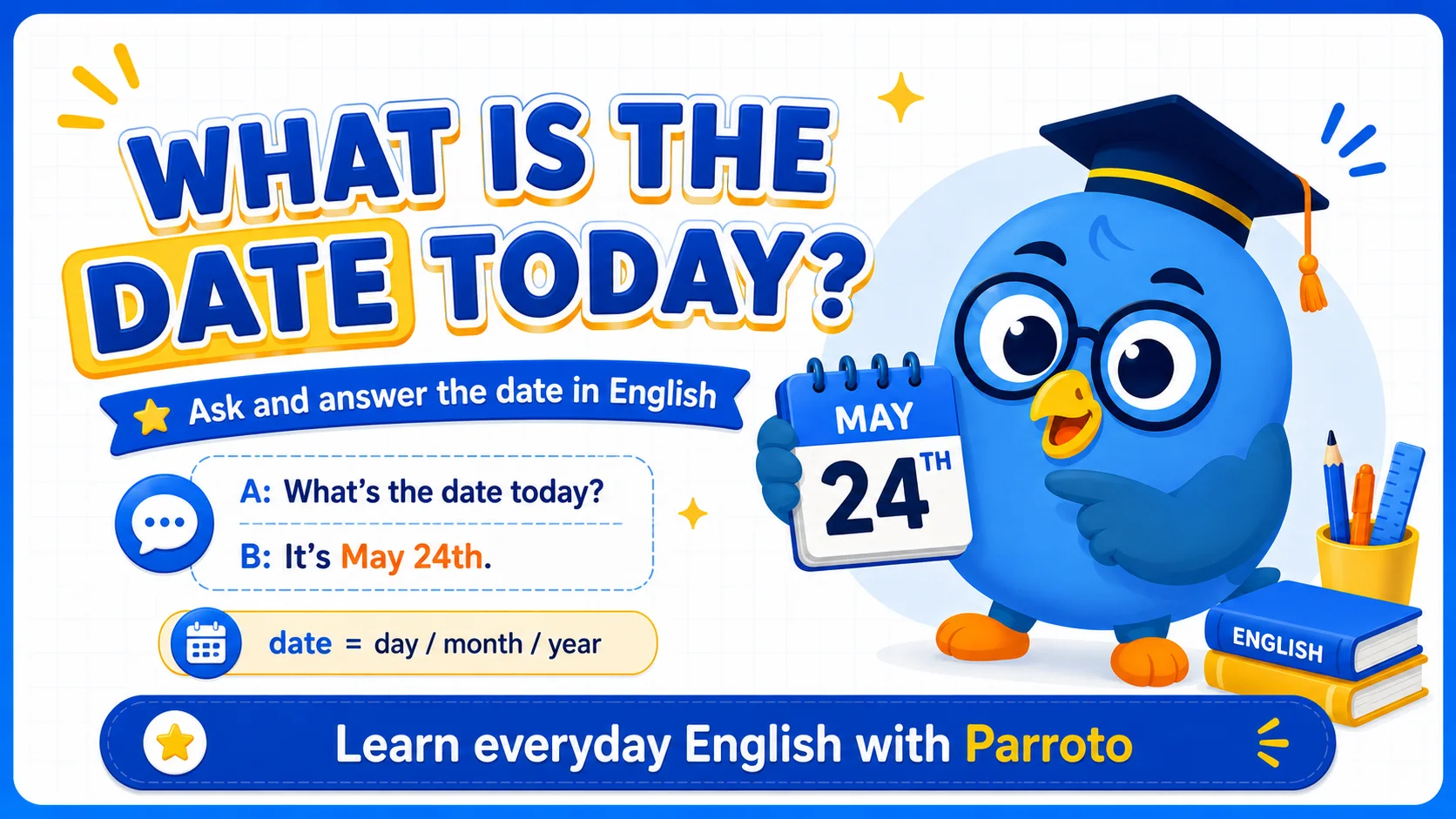
In daily English communication, the question “What is the date today?” appears quite frequently, especially when you need to ask for the date to fill out forms, schedule classes, make appointments, or check work deadlines. Though a simple phrase, many learners often confuse this question with asking for the day of the week. Let Parroto help you learn its natural usage and how to answer!
1. What does "What is the date today?" mean?
"What is the date today?" means "Hôm nay là ngày mấy?" or "Hôm nay là ngày bao nhiêu?" (What date is it today?)
This question is used to ask about a specific day, month, and year.
For example:
A: What is the date today?
(Hôm nay là ngày mấy?)
B: It is May 24th.
(Hôm nay là ngày 24 tháng 5.)
You can also say it more concisely as:
What’s the date today?
(Hôm nay là ngày mấy?)
2. How to answer "What is the date today?"

When answering, you can use one of two common structures:
Today is + date.
It is + date.
For example:
Today is May 24th.
(Hôm nay là ngày 24 tháng 5.)
It is May 24th, 2026.
(Hôm nay là ngày 24 tháng 5 năm 2026.)
In daily conversation, if the listener already knows the current year, you only need to state the day and month. If writing in an email, contract, or important document, you should include the year for clearer information.
3. Other ways to ask for the date
Besides "What is the date today?", you can use a few other phrases:
What’s today’s date?
(Hôm nay là ngày mấy?)
Can you tell me today’s date?
(Bạn có thể cho tôi biết hôm nay là ngày mấy không?)
Do you know what today’s date is?
(Bạn có biết hôm nay là ngày mấy không?)
Could you tell me the date, please?
(Bạn có thể vui lòng cho tôi biết ngày hôm nay không?)
These phrases all have similar meanings, but their formality can vary. In informal communication, you can use "What’s today’s date?". In more polite situations, use "Could you tell me the date, please?".
4. Differentiating "Date" and "Day"
English learners often confuse "date" and "day." Both words relate to time but are used differently.
"Day" is used to ask about the day of the week.
For example:
What day is it today?
(Hôm nay là thứ mấy?)
It’s Sunday.
(Hôm nay là Chủ nhật.)
"Date" is used to ask about a specific day of the month.
For example:
What is the date today?
(Hôm nay là ngày mấy?)
It’s May 24th.
(Hôm nay là ngày 24 tháng 5.)
Therefore, if you want to ask "hôm nay là thứ mấy" (what day of the week it is), use "day." If you want to ask "hôm nay là ngày bao nhiêu" (what date it is), use "date."
5. How to write dates in English
In English, dates can be written in two common styles.
According to British English, the order is usually:
Day – Month – Year
For example:
24 May 2026
24th May 2026
According to American English, the order is usually:
Month – Day – Year
For example:
May 24, 2026
May 24th, 2026
When writing in lessons, emails, or documents, you should stick to one style to avoid confusion.
6. Sample dialogue
A: What is the date today?
(Hôm nay là ngày mấy?)
B: It’s May 24th. Why?
(Hôm nay là ngày 24 tháng 5. Sao vậy?)
A: I need to write the date on my homework.
(Mình cần ghi ngày vào bài tập.)
B: Don’t forget to add the year if your teacher asks for it.
(Đừng quên thêm năm nếu giáo viên yêu cầu nhé.)
Conclusion
"What is the date today?" is a simple yet very useful phrase in daily communication. This phrase is used to ask for a specific date, different from "What day is it today?" which asks for the day of the week. To answer, you simply use the structure "Today is…" or "It is…" followed by the date.
With Parroto, you can learn common conversational phrases through real-life contexts, practice listening, improve pronunciation, and memorize vocabulary more effectively every day.

