
Meeting Minutes (MoM): How to Write International Standard Meeting Minutes
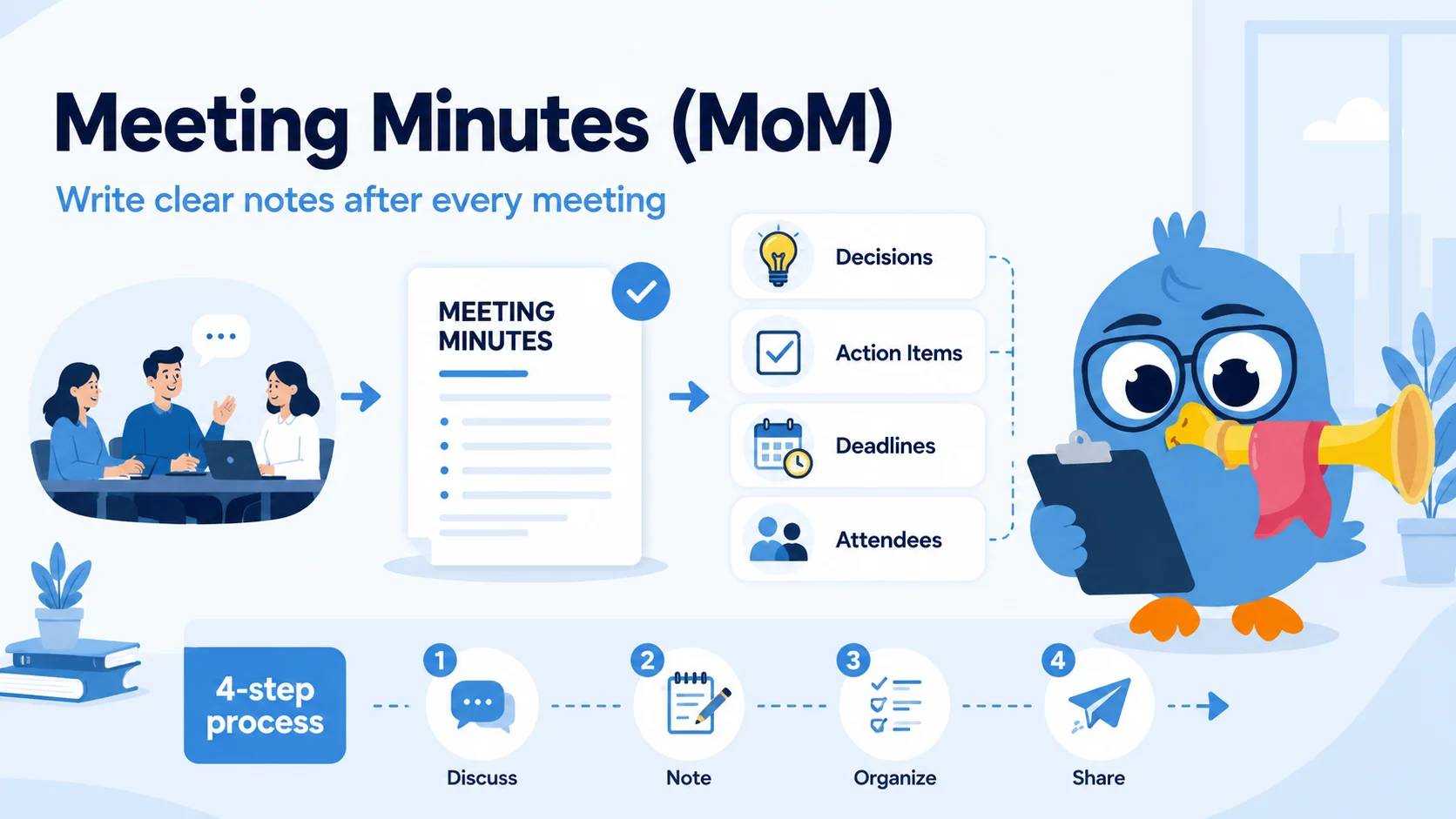
After every meeting, what determines whether work progresses often isn't what was said, but what was recorded. Clear Meeting Minutes ensure that every decision, every task, and every deadline is explicitly documented. This article will help you understand what Meeting Minutes are, what a complete set of minutes should contain, essential vocabulary and sentence structures, three common formats, a four-step process for effective writing, and how to differentiate them from Agenda and Meeting Notes.
What are Meeting Minutes?
Meeting Minutes are the official record of a meeting, a formal document used to capture key discussions, decisions made, and action items that arose during the session. It's not a verbatim transcript, but a distillation of valuable information for future reference and a clear assignment of responsibilities.
Many still wonder about the difference between "Minutes of meeting" and "Meeting Minutes." In reality, these are just two ways of referring to the same thing, with "Minutes of meeting" being the more complete and formal name, while "Meeting Minutes" (abbreviated MoM) is the common usage. Both have the same validity in a professional setting.
In terms of application, Meeting Minutes appear in almost all internal meetings, project meetings, board meetings, and even working sessions with international partners. All participants use them as a basis for task implementation, while absentees rely on them to catch up on developments. The person responsible for taking notes is usually the meeting secretary or a designated individual, and the minutes need to be submitted to the chairperson for review and signature before being distributed to all relevant parties.
Five Elements for Complete Meeting Minutes
A professional minute-taker doesn't need to transcribe everyone's words verbatim, but rather synthesize information to focus on the outcomes. First is the basic information, including the meeting title, start and end times, and location, whether it's at the office or via an online meeting link. Next is the attendance, where you list all attendees and absentees, including reasons if any, for easy tracking of responsibilities later.
The body of the minutes revolves around three important blocks. Key discussion points should be summarized concisely and objectively, highlighting arguments and noteworthy contributions. Decisions made must be recorded accurately, including goals, plans, or solutions agreed upon by all parties, to avoid future disputes. Most importantly, the Action Items section clearly lists each task to be done, who is responsible, and the corresponding deadline. It is the Action Items that transform a meeting into actual work, so never write them vaguely.

To confidently participate in and conduct international discussions, mastering industry-specific terminology is essential, helping you correctly understand messages from all parties and making your minutes more accurate and professional.
Some terms related to decision-making and voting that you should know include consensus, unanimous, motion, seconded, cast a vote, resolution, and compromise. The group related to organizing and conducting meetings includes chairperson, agenda, quorum, objective, Any Other Business (AOB), wrap up, and adjourn. Finally, the group related to people and post-meeting actions includes absentee, proxy, action items, implement, follow up, and postpone. Grouping words by their functional clusters like this will help you react much faster than learning them in isolation.
Professional Sentence Structures for Meeting Minutes
Using correct sentence structures makes minutes concise and easy to follow, and it's also a way to impress superiors and colleagues.
When needing to record a decision, the classic sentence structure is
"It was agreed that…" meaning "Everyone agreed that…", for example, "It was agreed that the new marketing strategy will be launched next month" or "It was agreed that we should focus on improving customer service quality first."
If the decision comes from an approval level, you can use "The board approved the proposal to…" meaning "The board approved the proposal to…", for example, "The board approved the proposal to increase the project budget by 15%."
When assigning tasks, clearly state the responsible person using the structure
"[Name] is responsible for…", such as "Ms. Hanh is responsible for preparing the quarterly financial report" or "The IT team is responsible for upgrading the internal server system."
To attach a deadline to a task, the appropriate sentence is "[Task] must be completed by [Date]", for example, "The final design version must be completed by June 20th" or "All survey feedback must be completed by the end of this week." These sentence structures, though simple, will make your minutes look very professional if used consistently.
Three Common Meeting Minutes Formats
Depending on the nature of the meeting, you should choose the appropriate minute format instead of applying a rigid template.

The Word or PDF format is the most formal, suitable for high-level meetings such as board meetings, director meetings, or official working sessions with partners. The document structure is detailed, easy to print, and convenient for signing and record-keeping. The Excel format is designed as an intuitive spreadsheet in an action plan style, focusing on tracking work progress. This is a powerful tool for project managers who need to monitor multiple tasks simultaneously, assign responsibilities, and continuously control deadlines. Finally, the email format, the most minimalist, is often sent directly in the body of the message without attachments. This format is ideal for a quick recap after internal meetings or weekly syncs, helping everyone grasp decisions and tasks in just a few lines.
Four-Step Guide to Writing Effective Meeting Minutes
Scientific and comprehensive minutes often result from a systematic process, spanning from preparation to distribution.
The first step is preparation based on the Agenda. Ask the chairperson for the agenda before the meeting, then pre-structure the minutes according to the main topics. This saves time and helps you adhere to the meeting's structure from the outset. The second step is smart note-taking during the meeting. Don't try to transcribe every word; instead, focus on keywords, specific figures, notable counter-arguments, and especially major decisions made.
The third step is drafting the complete minutes. You should write the full minutes immediately after the meeting ends, as the context and nuances of the discussion are still fresh in your mind, which brief notes might not fully convey if left too long. The final step is review and sharing. Before sending the official version to all members, forward the draft to the chairperson or direct manager to verify the accuracy of figures and decisions, then file and distribute it.
Differentiating Meeting Minutes from Meeting Agenda and Meeting Note
These three documents are often confused despite having completely different roles. A Meeting Agenda is a program of topics, prepared and sent before the meeting to guide the content to be discussed; it is provisional and usually drafted by the chairperson or secretary for all members. A Meeting Note is a personal record, written during the meeting, temporary and informal, serving only the writer's personal reminder needs. Meeting Minutes, on the other hand, are the official record, prepared after the meeting to confirm decisions and responsibilities, have long-term reference value, and are sent to all members and relevant parties. In short, Agenda is a pre-meeting plan, Note is a personal in-meeting jotting, and Minutes are a formal post-meeting commitment.

Practice Reflexive Keyword Catching in English Meetings with Parroto
The biggest challenge when taking minutes for an English meeting isn't writing, but keeping up with fast speech, overlapping voices, and jargon. This is precisely the skill that dictation practice directly hones. With Parroto, you listen to a real conversation, then type it out word-for-word. AI immediately points out any words you missed or misheard, thereby making your keyword-catching reflexes faster and more accurate with each practice session.
To specifically prepare for workplace contexts, you can choose exercises from the Business English topic in Parroto's library of over 3,000 lessons, ranging from A1 to C2, to familiarize yourself with the exact type of vocabulary and expressions that appear in meeting rooms. If you want to further develop your fluency in discussions, the one-on-one speaking practice feature provides a space for you to practice conversation with a real person at your appropriate level. We design each lesson to be just a few minutes long so you can maintain consistent daily practice, turning listening practice into a light habit instead of a heavy task.

