

The Listening skill is one of the biggest challenges for many IELTS candidates. If you feel stuck in improving your Listening band score, you might not have found a truly effective learning method yet. Don't worry, because the Dictation method – also known as listening and transcribing – is the "golden key" to help you not only master English listening skills but also conquer your dream IELTS Listening goal. With the support of modern tools like Parroto.app, practicing will become easier and more optimized than ever.
In this article, we will delve into exploring the dictation method, from its concept, different forms, the amazing benefits it brings, to how to effectively apply it to the IELTS Listening preparation process. Finally, Parroto will suggest the best materials and tools for you to start your journey of improving your listening skills today.
I. Unlocking the Dictation Method
1. What is Dictation (Listening and Transcribing)?
The Dictation method, or listening and transcribing, is a long-standing language learning technique that still retains its value in training English listening skills, especially for those learning and preparing for IELTS. Essentially, Dictation is the process of listening to an audio segment in English (which can be a word, a sentence, or a short passage) and then accurately writing down what you have heard.
This is not just a simple writing exercise; it requires high concentration on every phoneme, intonation, and sentence structure. From traditional school environments to online English courses, listening and transcribing has been recognized as a useful method for strengthening language foundations. Language researchers and educators, such as Mario Rinvolucri and Paul Davis in their book “Dictations: New Methods, New Possibilities”, have emphasized the importance of converting English audio into text. Jan Frodesen, a linguistics lecturer at the University of California, also recognized Dictation as a powerful tool for identifying and correcting grammatical and pronunciation errors that learners often make. Clearly, practicing dictation is an indispensable part of improving Listening skills.
2. Common Types of Dictation

In the study “Dictation in Language Learning” by Sawyer and Silver (1961), the Dictation method is classified into four main types, each serving a distinct learning objective:
Phonemic Item Dictation: This is the most basic form, focusing on identifying and recording individual sounds (e.g., symbols in the IPA phonetic chart). This form is particularly effective in helping learners distinguish and grasp the characteristic sounds of English, thereby improving pronunciation and listening ability. With Parroto, you can easily repeat difficult sounds and compare them with standard phonetics.
Phonemic Text Dictation: A further step, this form requires learners to listen to a text passage and transcribe the phonetics of the entire passage. It helps learners understand how phonemes change and connect in natural speech, training faster and sharper listening skills.
Orthographic Item Dictation: Similar to a traditional spelling test, you will listen to individual words and write them down accurately. This form is extremely important for reinforcing the connection between sound and spelling of words, reducing writing errors, and helping you memorize vocabulary more effectively.
Orthographic Text Dictation: This is the most comprehensive form, requiring you to listen to and transcribe an entire passage. In addition to strengthening the connection between spelling and sound, this form also helps identify weaknesses in learners' comprehension, grammatical structures, and vocabulary, allowing for suitable improvement plans. Parroto provides dictation exercises with increasing difficulty, allowing you to practice this form systematically.
3. Outstanding Benefits of the Dictation Method
Scott Alkire, an English lecturer at San Jose State University, has pointed out many benefits that Dictation brings to language learners. Parroto summarizes the following highlights:
Identify and overcome common pronunciation and grammatical errors: Dictation forces you to pay attention to every audio detail, helping you recognize subtle differences in easily confused sounds, for example:
- The
-ssound in plural nouns (e.g., cars). - The
-’ssound in possessives (e.g., a car’s wheel, cars’ doors). - The
-sor-essound when conjugating verbs in the third person singular (e.g., She enjoys dancing). - The
-edsound in past simple verbs, perfect tenses, or passive voice (e.g., He finished his homework).
- The
Improve spelling and reduce spelling errors: When trying to write down each word accurately, you will automatically train your spelling ability and recognize your frequent spelling mistakes (e.g., tomorrow instead of tommorrow).
Enhance listening comprehension and note-taking skills: Dictation helps you practice processing auditory information, especially with complex sentences, advanced grammatical structures, or profound meanings. You will learn to grasp main ideas and details more effectively (e.g., "When you receive a request like that, you cannot fail to obey it.").
Develop accurate sentence construction skills: By transcribing standard sentences from native speakers, you will gradually develop the mindset of arranging words and sentence structures correctly, avoiding awkward expressions (e.g., correcting "She is a surgeon of hearts" to "She is a heart surgeon").
Comprehensive proficiency assessment tool: This method is a comprehensive test of listening, writing, grammar, and vocabulary. In exams like IELTS Listening, the skill of accurately transcribing answers from conversations is extremely important. Parroto helps you practice this skill realistically.
Another big plus is that the dictation method is suitable for all levels, from beginners (band 4-5) to those with a solid foundation (band 8+). You can easily identify and correct your own mistakes during the learning process, optimizing your progress. Parroto, with its diverse practice levels, will be your ideal companion.
II. Optimizing Listening Skills with the Dictation Method Using Parroto

If you are struggling with the Listening section of the IELTS exam, Dictation is a powerful assistant. To maximize its effectiveness, follow these steps, making the most of Parroto.app:
Step 1: Prepare materials and vocabulary
- On Parroto.app, you can easily select listening exercises suitable for your level and goals. Before you start listening, review the transcript (if available) to familiarize yourself with the topic and note down any unfamiliar words. Look up their meanings, pronunciations, and usage examples. Parroto allows you to create flashcards from these new words for later review.
Step 2: Practice listening and dictation
- Turn on the audio recordings or videos on Parroto and begin the dictation process. Please note:
- Listen to individual sentences or short segments: Avoid listening to too many sentences at once to prevent confusion and missing information. Parroto allows you to loop individual sentences or adjust playback speed to catch up on information, especially useful when your listening proficiency is limited.
- Do not repeat too many times: Limit listening to a sentence more than twice consecutively if you still haven't transcribed it completely. Instead, try moving on to the next sentence, complete the entire listening exercise, and then return to the blank or difficult spots later. This helps you train your ability to infer context and avoid getting stuck on one detail for too long.
- Overall check: After listening to the entire exercise, listen again once to check if you missed any information. Pay special attention to the words or phrases you left blank, as these are often the "weak points" you might encounter in the actual exam.
Step 3: Compare and Analyze Errors
- Open the full transcript on Parroto and compare it with your transcription. Use Parroto's highlight tool to mark where you misheard or fill in missing parts. Analyze why you made mistakes: was it due to vocabulary, grammar, unclear pronunciation, or too fast speaking speed? This process is very important for you to learn from your experience.
Step 4: Practice Shadowing to improve pronunciation and intonation
- After mastering the content and correcting errors, move on to the Shadowing step. On Parroto.app, play the audio sentence by sentence, pause, and repeat exactly what you just heard. Try to mimic the intonation, stress, and speaking speed of native speakers. Especially focus on words or phrases you often made mistakes with during the previous dictation practice. Shadowing is an excellent technique to improve pronunciation and help your ears get more accustomed to English sounds.
III. Effective English Dictation Practice with Parroto
1. Which Materials Should You Use for Dictation Practice?
To achieve the highest effectiveness in improving IELTS Listening, choosing appropriate materials is crucial. Listening passages from standard IELTS Listening tests are ideal resources. They feature clear monologues/conversations, easy-to-understand meanings, and diverse topics, close to life and academia, helping you easily get acquainted with the exam format. Furthermore, all IELTS Listening exercises come with full transcripts, which is extremely convenient for your review and error-checking process. Parroto provides a rich library of continuously updated IELTS Listening materials.
2. Where is the Best Place to Practice Dictation?
Are you looking for a comprehensive platform to practice dictation and improve your IELTS Listening skills? Look no further, Parroto.app is the optimal solution for you!
Discover the Power of Parroto – Elevate Your IELTS Listening:
Parroto is not just a simple listening practice app but also a personal assistant that helps you master every aspect of the Listening test with a scientific and effective Dictation method:
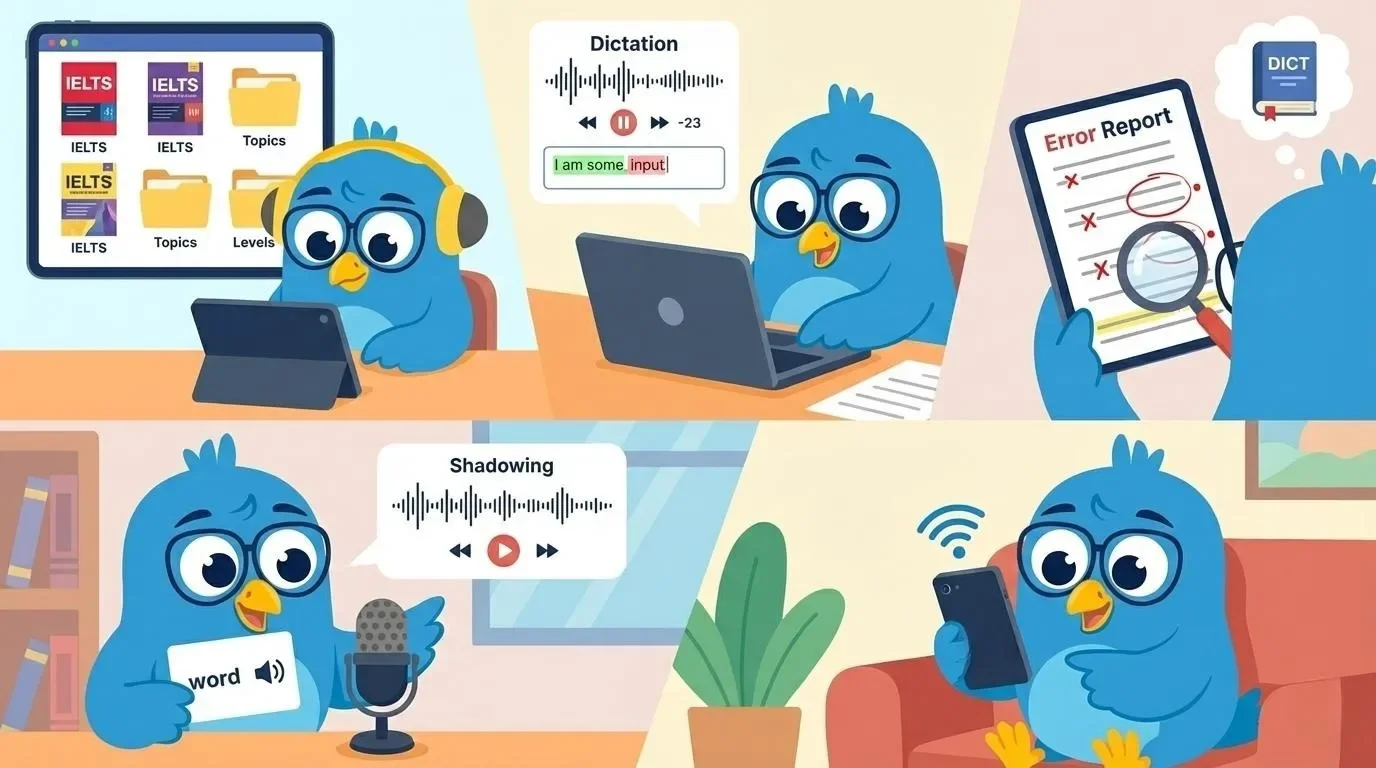
Diverse, IELTS-standard library: Access thousands of IELTS Listening exercises categorized by question type, difficulty, and topic. From basic practice to the latest mock tests, Parroto is always ready to meet all your needs.
Smart Dictation tool: With a friendly interface, Parroto allows you to adjust listening speed, loop audio segments, and even automatically pause after each sentence so you have enough time to transcribe. You can type what you hear directly into the system, and Parroto will automatically compare it with the original transcript.
Detailed error analysis: After completing the dictation exercise, Parroto will highlight spelling, grammar, or missing word errors, helping you easily identify your weaknesses. You can click on the incorrect word to see explanations or suggested corrections.
Integrated vocabulary learning: Any new word you encounter in the transcript can be saved to your personal vocabulary notebook, automatically creating flashcards for periodic review. Parroto helps you not only listen well but also build a solid IELTS Listening vocabulary.
Convenient Shadowing practice: The integrated Shadowing feature helps you practice pronunciation and intonation right on the platform. You can replay each sentence and practice repeating, improving fluency and speaking confidence.
Learn anytime, anywhere: With Parroto.app, you can turn every spare moment into a learning opportunity. Wherever you are, as long as you have an internet-connected device, you can start your journey to improve your listening skills.
➡️ MAKE IELTS LISTENING YOUR STRONGEST SKILL ONLY WITH Parroto!
Visit https://parroto.app/ now to explore courses and dictation exercises designed optimally, helping you quickly achieve your desired IELTS Listening band score.
Conclusion
The dictation method, despite its long history, still proves to be one of the indispensable and most effective ways to learn Listening in the modern English learning world. Especially for those who wish to improve their IELTS Listening skills and achieve a high band score, combining Dictation with a smart tool like Parroto.app will be an excellent choice.
We hope that this article has provided you with a comprehensive overview and specific instructions for you to confidently and effectively begin your journey to conquer IELTS Listening. Don't hesitate, start practicing Dictation with Parroto today and feel the difference! Visit https://parroto.app/ to start your experience!