
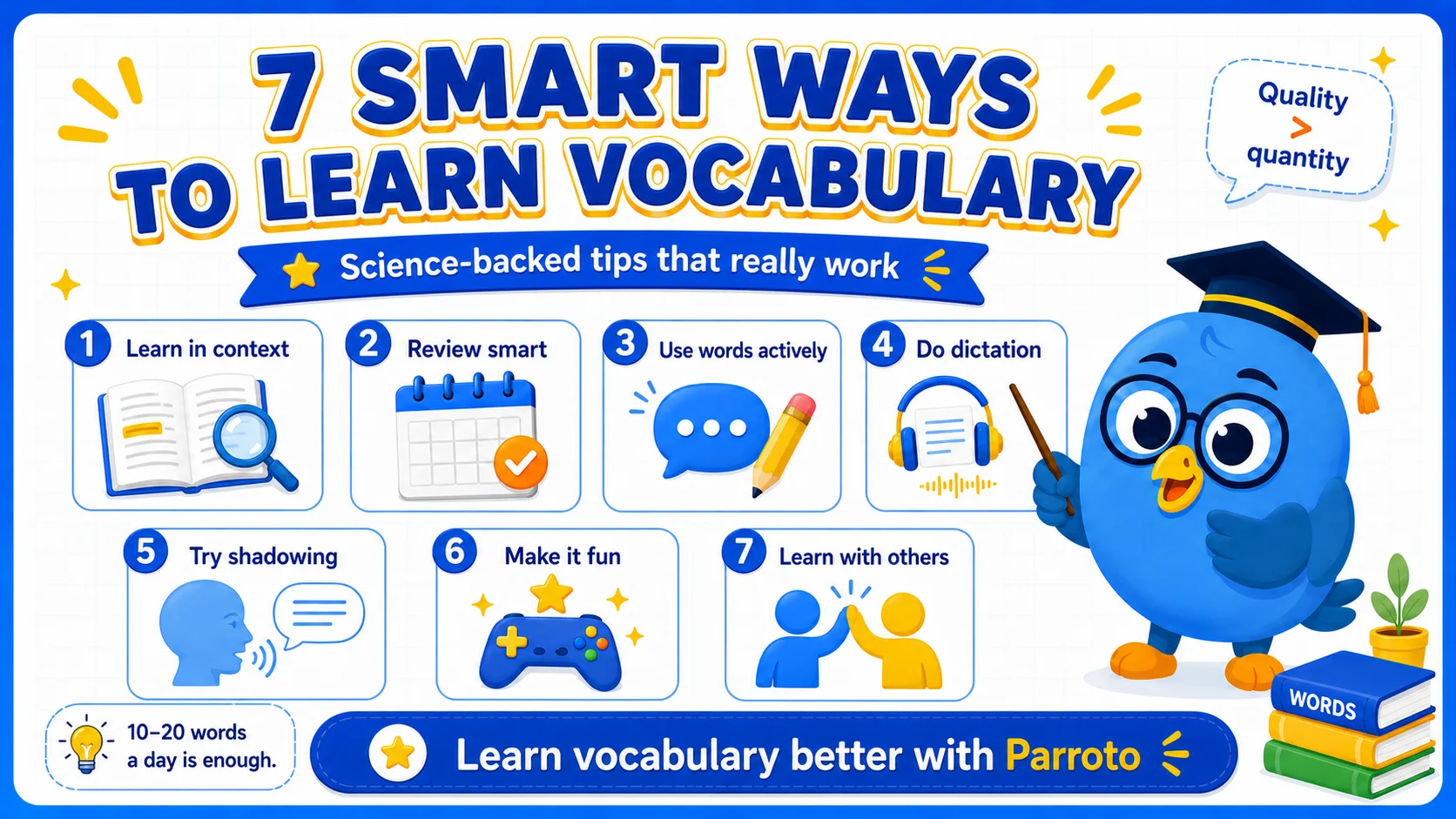
Have you ever sat down to copy a list of 50 new words, memorized them all evening, only to completely forget them three days later? Almost everyone learning English has experienced this situation.
The problem isn't with your memory. The problem lies in the learning method. Most of us are taught vocabulary in the least effective way: copying lists, learning isolated meanings, and then hoping they 'stick.' This article synthesizes science-proven truly effective vocabulary learning tips – complete with specific application methods so new words no longer 'go in one ear and out the other'.
1. Learn Words in Context, Not Isolated Lists

This is the most important tip, and also what many people get wrong.
When you learn the word "appreciate" with the dry meaning "đánh giá cao / trân trọng" (to highly value / cherish), your brain has nothing to 'hook' that word onto. It floats around, unconnected, and is quickly forgotten.
But when you hear the sentence "I really appreciate your help" in a movie clip, you gain more than just a meaning: you see who uses the word, in what situation, what structure it accompanies, and what the intonation is like. The word then has an 'anchor' in your memory.
How to apply: Instead of learning words from lists, learn them through authentic content — movies, videos, songs, news. Every new word you encounter is already embedded in a meaningful sentence. This is the principle of contextual vocabulary learning.
2. Spaced Repetition — Review Just Before You Forget

The human brain forgets according to a fairly consistent pattern: after learning, memory declines quickly in the first few days, then slows down. If you review just before you're about to forget, your memory is 'recharged,' and next time, forgetting happens much slower.
This is the principle of Spaced Repetition — currently the most effective vocabulary review method.
How to apply: Don't review all words every day (it's both tiring and a waste of time for words you already know). Let a smart system choose automatically: words you're about to forget will be prioritized for review, while firmly remembered words will have their review intervals extended. Vocabulary flashcard apps with SRS algorithms do exactly this — you just need to show up consistently, and the system handles 'when to review'.
3. Actively Use Words
There are two levels of knowing a word. Passive recognition is when you see a word and recall its meaning. Active usage is when you can spontaneously produce that word when needed for speaking or writing. Rote memorization only creates the first level. But communication demands the second. That's why many people 'know' thousands of words but still stumble when speaking — they recognize the words but can't retrieve them.
How to apply: After learning a word, force yourself to use it. Say a sentence containing that word. Mimic the original sentence containing the word until it flows naturally. The Shadowing method is very powerful here: when you speak along with a native speaker, the vocabulary doesn't just stay in your head but also enters your mouth's 'muscle memory' — next time you need it, it will come out naturally.
4. Listen — Training Your Ear is Also Training Vocabulary
A fact few people notice: you might 'know' a word on paper but still not recognize it when you hear it. This is because native speakers speak quickly, link sounds, and omit sounds — familiar words suddenly sound strange. Learning vocabulary while neglecting listening skills is only learning half the battle.
How to apply: Practice Dictation — listen to a sentence and type out each word precisely. This method forces you to discern every word instead of guessing. And it has a wonderful side effect: every time you mishear a word, you immediately discover a gap — 'ah, this word sounds like that when spoken quickly.' This is a type of vocabulary learning deeply connected to authentic sound.

5. Gamify Your Vocabulary Review
The biggest reason people give up on vocabulary learning isn't because it's hard — but because it's boring. Copying words, flipping flashcards, testing... repeating it all becomes tedious.
Motivation science shows that when a task has elements of challenge, scores, and instant feedback, the brain releases dopamine, and we want to continue. This is why games are addictive — and we can absolutely 'borrow' that mechanism for learning.
How to apply: Instead of traditional word review, choose a gamified approach — for example, a fast-paced game-like vocabulary practice mode where you must react and select the correct meaning before time runs out. It's fun, and it trains your speed in retrieving words from memory. A 10-minute review session suddenly becomes a short game rather than an obligation.
6. Learn With Others — Don't Learn Alone
Learning alone makes it very easy to give up. No one sees your progress, no one reminds you when you slack off, and when you feel discouraged, there's no one to lean on. Community factors and a bit of healthy competition can completely change the sustainability of your learning habit.
How to apply: Join a study group, compare vocabulary leaderboards with others, or participate in competitive vocabulary challenges. When learning words becomes an 'arena' — where you compete to see who remembers more words, who maintains a longer learning streak — external motivation helps you overcome lazy days. Sharing your vocabulary sets with others, or learning from sets created by others, also makes learning much less lonely.
7. Prioritize Input Quality, Don't Chase Quantity
Learning 100 words a day sounds very 'productive,' but if you forget 90 of them three days later, you've essentially only learned 10. Whereas learning 15 words a day and remembering all 15 firmly is far more effective.
How to apply: Set realistic goals — 10 to 20 new words a day, but learn them 'deeply': encounter them in context, be able to hear them, speak them, and review them on schedule. Slow and steady always wins over fast and superficial when it comes to vocabulary learning.
Conclusion
Effective vocabulary learning isn't about copying more or studying later into the night. It's about: learning words in authentic contexts, reviewing just before you forget, actively using words through listening and speaking, turning review into a game, and learning within a community to maintain motivation.
Learn Vocabulary the Right Way with Parroto
The hardest part about applying the tips above is that they are scattered across many different tools — one app for listening, another for flashcard review, another group for learning with others. Parroto brings everything into one place, precisely following the principles in this article.
With Parroto, you learn vocabulary in authentic contexts from over 3,000 video clips of movies, news, and conversations — just tap any word to look up its meaning right in the sentence. You practice Dictation to discern every word and Shadowing to actively use words, with AI scoring errors down to each word. Difficult words are saved to flashcards for review using a spaced repetition algorithm, and you can quickly review them through a game-like 'vocabulary shoot-out' mode to avoid boredom.
Equally important, you don't learn alone: the vocabulary arena with leaderboards creates motivation for friendly competition, while the Parroto community is where you can share your word sets, learn from others' sets, and find study buddies. All of this is packed into short 15-minute daily study sessions — light enough to maintain, consistent enough to see results.

